Seeing it before it is built
Two clickable stubs in the chat for a minute of tokens. One tap picks the right one, and only that one gets built.
Ask for a screen and an agent will spend an hour on state, data and edge cases —
and then you look at it and say not like that.
Sketch first is the switch that stops that happening. It is in the +
sheet, at the top.
What you get
With it on, an agent that is about to build a screen builds the dumb version
first: one screen, fake data, nothing wired up, every button dead but every
button responding. It takes minutes rather than an hour.
Then it asks you which one, and the options in that question are the pages
themselves — live, in the chat, pressable with a thumb. You tap the one you
want and only that one gets built for real.
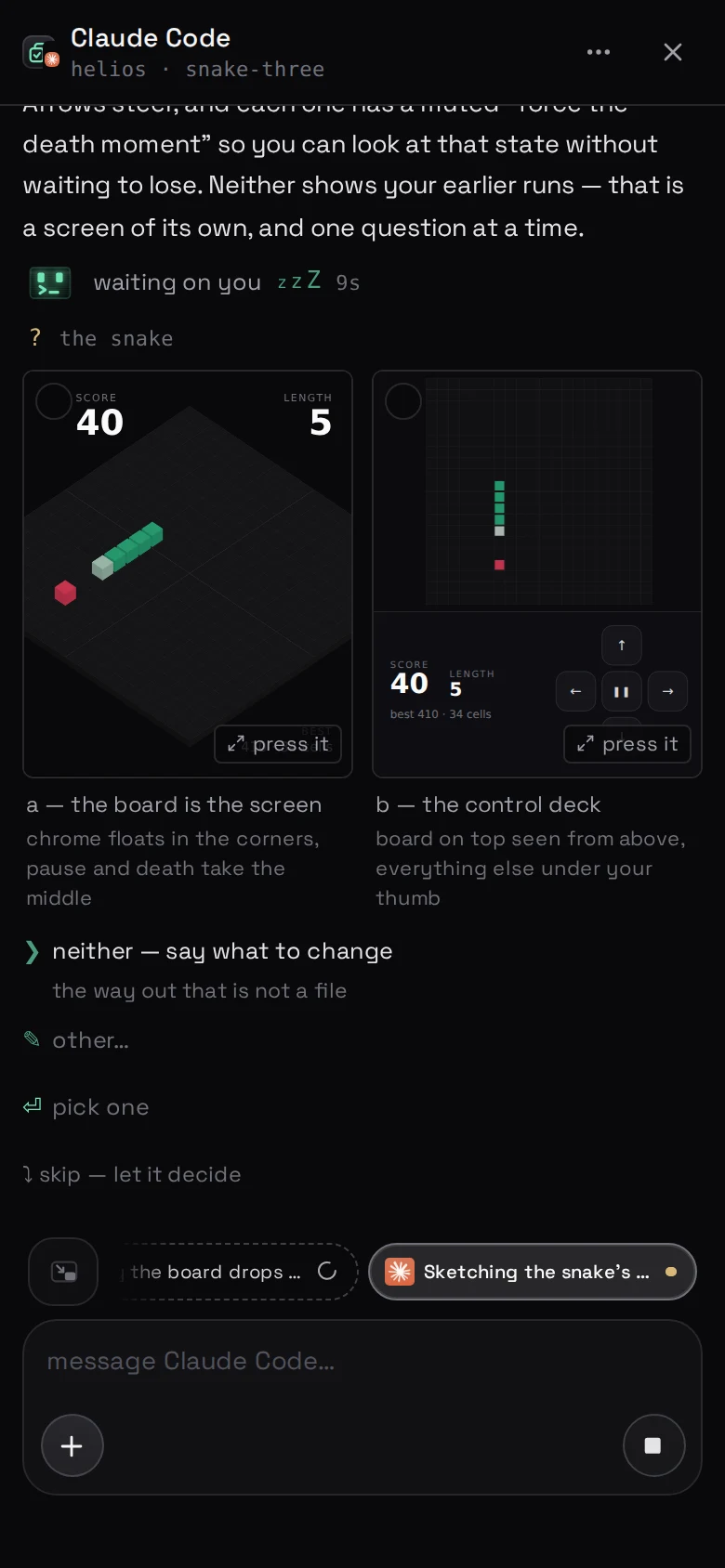
Why two, and not five
Two fit side by side on a phone, so the comparison is one glance. Three when the
choice genuinely has three arms. More than that and it is a form.
It is the real thing, roughly
The stubs are built in your project's own framework, with your project's own
stylesheet, so the colours, the type and the components are yours.
Everything is inlined into one self-contained page: nothing is fetched, so it
works on a phone in a frame with no network behind it.
Words are sketched too
The same thing works for copy. Three headlines are a sketch of the headline:
nothing built, and the words themselves are the options. Handy on a landing
page, an empty state, or a button nobody has named yet.
Then keep going
An answer is rarely just "b". It is "b, but the header is too big" — another
minute and another sketch, not the start of the real work. Being wrong is cheap
right up until the moment you say yes.
The other half
A sketch asks; a picture proves. Once a thing is built, the agent posts what it
made into the same thread — see pictures, both ways.
When to leave it off
When you have already said exactly what to build. Sketching something you just
specified is asking somebody to decide twice.